![Shaanxi Lingkang Times Biotechnology Co., LTD]() Shaanxi Lingkang Times Biotechnology Co., LTD
Shaanxi Lingkang Times Biotechnology Co., LTD

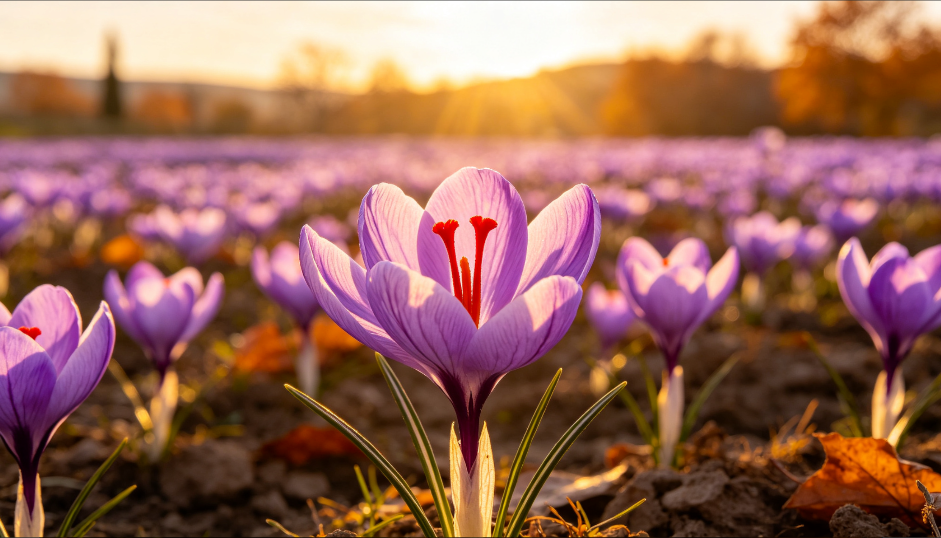
Saffron crocus fields at harvest — the red stigmas are all that is used.
If saffron only shows up in your life as the expensive spice in the back of the kitchen cabinet, you might have missed where it has been appearing lately: supplement labels. Saffron extract and its main active compound, crocin, now show up in products for eye health, mood and sleep.
There is a distinction most people skip over, and it matters whether you are shopping as a consumer or sourcing ingredients for a product. The saffron threads you steep in hot water are not the same thing as a standardized extract. This guide covers what crocin is, what the research actually supports, and how to tell a good saffron extract from a weak one.
Saffron (Crocus sativus) earns its reputation as one of the world's most expensive spices honestly. Each purple flower yields just three red stigmas, picked by hand. As a rough industry benchmark, it takes well over a hundred thousand flowers to produce a single kilogram of dried saffron.
Those three stigmas carry the plant's active compounds:
· Crocin — a water-soluble carotenoid glycoside and the main red pigment; the most studied saffron compound, and the usual metric for standardizing saffron extract
· Crocetin — crocin's aglycone
· Safranal — responsible for saffron's distinctive aroma
· Picrocrocin — the source of its bitter taste
So crocin is not saffron — it is the compound inside saffron that researchers have studied most, and the one most commonly used as a quality standard. When you see saffron extract on a label, the crocin content is usually what defines the specification.
A quick note before the list: these are observations from published studies — promising, but not a cure, and not medical advice.
Eye health — the most solid evidence base. Multiple clinical trials have reported benefits for visual acuity and macular function at roughly 20–50 mg of saffron extract per day, or about 5–15 mg of crocin. Age-related macular degeneration research has been especially active.
Mood and sleep — one randomized controlled trial found 30 mg of saffron extract per day performed close to fluoxetine in people with mild-to-moderate low mood, with fewer reported side effects. Sleep research exists but is less mature.
Antioxidant and metabolic support — crocin shows clear antioxidant and anti-inflammatory activity; animal studies report increased SOD and CAT enzyme activity, and clinical work has looked at lipid markers in people with metabolic syndrome.
Neuroprotection — mostly early-stage. Much of the evidence sits in cell and animal models (for example, Alzheimer's research), with human data still limited.
The honest summary: eye health has the strongest human evidence, mood has some human trials with modest samples, and most other directions remain in the lab.
Saffron threads and the deep red crocin pigment they carry.
Four Misconceptions About Saffron Extract
“I brew saffron tea, so I am getting the same effect.” Not really. Steeping dried stigmas delivers a variable, low amount of crocin that is not standardized — three threads today, five tomorrow, and no way to know the dose. A standardized extract has a measured, labeled crocin content.
“Is higher crocin content always better?” Content is one quality signal, not the whole story. For manufacturers, consistency is often the bigger concern: a batch that swings between high and low is more disruptive than one that sits steadily at a reasonable level.
“Does it work overnight?” Studies run for weeks and months; eye-health research often tracks results by the quarter. Expecting results the next day will disappoint.
“Can I just buy saffron and take it as a supplement?” Saffron is fine as a spice, but it is not something to take in large doses as a supplement. High intake carries safety risks, and caution is especially warranted during pregnancy. A spice-level amount and a clinical dose are different things.
Whether you are choosing a product or auditing a raw material, the same checklist applies:
· Source traceability — can the producer tell you where and how the raw material was sourced?
· Specification and assay method — what crocin content is claimed, and was it measured by HPLC?
· Third-party COA — an independent certificate of analysis, not just an in-house sheet
· Batch-to-batch consistency — do consecutive batches hold their specification?
· Application performance — does the extract stay stable in your formulation (color, taste, shelf life)?
If you are sourcing as a manufacturer, add the safety layer: heavy metals, pesticide residues, microbial limits, GMP compliance, and relevant certifications (Kosher, Halal, organic).
One purple saffron flower, three red stigmas.
Sourcing Saffron Extract for Your Product?
If you are formulating a supplement, food or beauty product and need a dependable saffron extract, we would be glad to share specifications, a third-party COA and samples. Contact us to start the conversation.
This article is for educational purposes and is not medical advice. Statements about crocin and saffron extract reflect published research observations, not claims to treat or cure disease. Always follow product instructions and applicable regulations.