![Shaanxi Lingkang Times Biotechnology Co., LTD]() Shaanxi Lingkang Times Biotechnology Co., LTD
Shaanxi Lingkang Times Biotechnology Co., LTD

In the global health and functional food market, anthocyanins have become one of the most sought-after natural active ingredients. Renowned for their powerful antioxidant, anti-inflammatory, skin-beautifying and metabolic-regulating properties, anthocyanin-rich fruits are widely used in functional beverages, dietary supplements, skincare raw materials, and healthy snack production. Most global buyers and consumers mistakenly regard blueberries as the top anthocyanin fruit, but professional nutritional detection data proves otherwise.
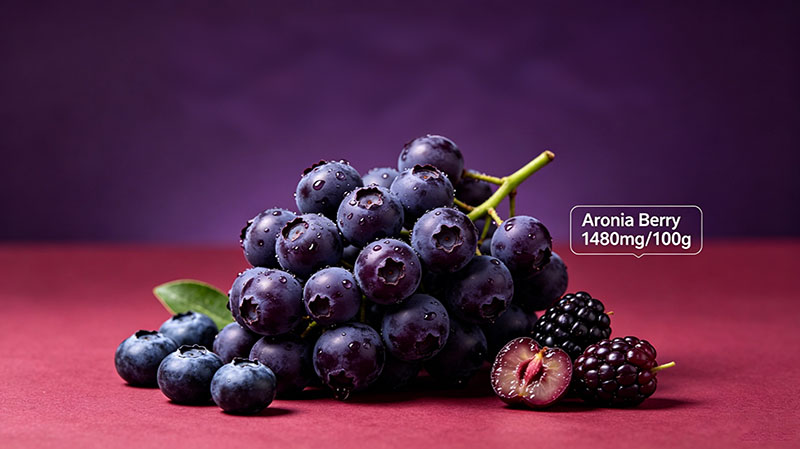
What fruit is highest in anthocyanins?
In this guide, we will reveal the highest anthocyanin-containing fruit, compare core data of mainstream high-anthocyanin fruits, and analyze their commercial value, application scenarios and wholesale advantages to support global importers, distributors and food manufacturers in making high-value procurement decisions.
1. The No.1 Anthocyanin Fruit: Aronia Berry (Aronia Melanocarpa)
Based on authoritative food nutrition databases and professional nutritional test reports, Aronia Berry (Wild Cherry Berry) ranks first among all fruits in terms of anthocyanin content, far exceeding classic high-anthocyanin fruits such as blueberries and mulberries.
Core Nutrition Data: 1480mg of anthocyanins per 100g of fresh Aronia berries, which is nearly 4 times that of ordinary blueberries and 3 times that of wild blueberries .
Aronia berry is a dark purple super berry native to Eastern Europe and North America. It features a compact fruit structure, high nutritional density, and extremely stable anthocyanin activity. Unlike other fruits whose anthocyanins are mainly concentrated in the peel, the anthocyanins of Aronia berries run through the entire pulp, ensuring maximum nutritional retention and utilization rate.
2. Top 8 High-Anthocyanin Fruits: Authoritative Content Ranking
To help buyers quickly screen high-quality raw materials, we have sorted the anthocyanin content of mainstream commercial fruits (per 100g fresh fruit) based on third-party professional detection data :
1. Aronia Berry: 1480mg (Top 1, absolute leader in anthocyanin content)
2. Black Raspberry: 589mg
3. Wild Blueberry: 558mg
4. Mulberry: 458mg
5. Acai Berry: 410mg
6. Ordinary Blueberry: 365–406mg
7. Raspberry: 365mg
8. Concord Grape: 326mg
The data fully proves that Aronia berry is the undisputed anthocyanin king of fruits in the commercial market, with a content gap that cannot be matched by other berry fruits.
3. Core Benefits of Aronia Berry Anthocyanins
As a high-purity natural anthocyanin raw material, Aronia berry has outstanding functional advantages, perfectly matching the current global trend of clean label and functional health food development:
Powerful Antioxidant & Anti-Aging
Anthocyanins are natural free radical scavengers. Long-term intake can effectively delay cell aging, improve skin elasticity, and reduce pigmentation, making Aronia berries a core raw material for anti-aging dietary supplements and skincare functional foods.
Boost Metabolism & Body Maintenance
Relevant studies in the International Journal of Molecular Sciences confirm that anthocyanins can promote human metabolism, regulate intestinal flora balance, and assist in daily body health management , suitable for weight management and sub-health conditioning functional products.
Anti-Inflammatory & Immune Support
High-purity anthocyanins have significant anti-inflammatory effects, help reduce chronic inflammatory reactions in the body, enhance immune function, and are widely used in daily health care products for all age groups.
Stable Activity & High Absorption Rate
Aronia berry anthocyanins have stable molecular activity, are not easy to decompose during processing, and have a high human absorption and utilization rate. Compared with blueberries and mulberries, they have higher cost performance in industrial production.
4. Commercial Application Scenarios
Aronia berry, as a high-value anthocyanin raw material, has wide market coverage and strong profitability, applicable to multiple mainstream tracks:
• Functional Beverages & Juices: Pure Aronia juice, compound berry drinks, zero-sugar health drinks
• Dietary Supplements: Anthocyanin capsules, antioxidant tablets, beauty and anti-aging oral liquids
• Healthy Snacks: Freeze-dried Aronia berries, berry granola bars, functional preserves
• Food Additives: Natural purple food coloring instead of synthetic pigments, clean label raw materials
• Skincare Raw Materials: Anthocyanin extracts for antioxidant and brightening skincare products
5. Why Choose Wholesale Aronia Berry Products?
1. Ultra-High Cost Performance
With 4 times the anthocyanin content of ordinary blueberries, Aronia berries have lower unit active ingredient cost, helping brands reduce raw material procurement costs and improve product competitiveness.
2. Clean & Safe Raw Materials
Our Aronia berries are cultivated with standardized ecological planting, free of pesticides and heavy metal residues, and have passed SGS, organic and other international certifications, meeting the strict food safety standards of Europe, America, Southeast Asia and other regions.
3. Diversified Supply Forms
We support customized supply of fresh fruits, frozen fruits, freeze-dried fruits, fruit powder and anthocyanin extracts, adapting to different production and processing needs of customers, and supporting OEM/ODM services.
4. Huge Market Potential
With the global rise of natural health and anti-aging consumption, high-purity anthocyanin functional products are in short supply. As the top anthocyanin fruit, Aronia berries have not yet achieved full market popularization, with huge market blank and profit space for distributors.
6. FAQ About High-Anthocyanin Fruits
Q1: Is blueberry the highest anthocyanin fruit?
No. Blueberry is a mainstream high-anthocyanin fruit, but its content is far lower than Aronia berry. Many merchants overmarket blueberry’s anthocyanin value, while Aronia berry is the real high-content anthocyanin raw material.
Q2: What is the daily anthocyanin intake standard?
The recommended daily intake of anthocyanins for adults is 50–250mg . A small amount of Aronia berry can meet daily nutritional needs, with higher intake efficiency than ordinary fruits.
Q3: What is the difference between Aronia berry and Acai berry?
The anthocyanin content of Aronia berry is 3.6 times that of Acai berry. Aronia berry has more stable active ingredients and lower processing difficulty, which is more suitable for large-scale industrial production and sales.