![Shaanxi Lingkang Times Biotechnology Co., LTD]() Shaanxi Lingkang Times Biotechnology Co., LTD
Shaanxi Lingkang Times Biotechnology Co., LTD

As plant-based nutrition gains global popularity, soy-derived nutrients have become essential choices for daily supplementation, fitness nutrition and functional healthcare. Soy peptide and soy protein are two core nutritional ingredients extracted from soybeans, yet they differ greatly in molecular structure, absorption efficiency and physiological functions. Understanding their unique characteristics helps people select suitable soy supplements for different physical needs and health goals.
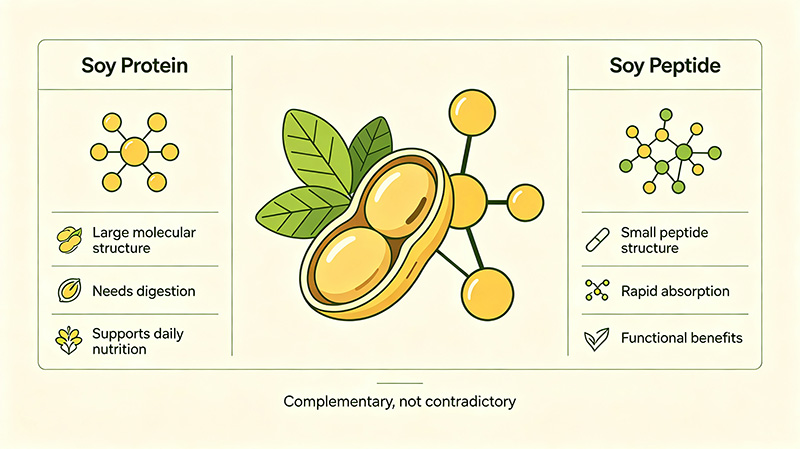
Soy Peptide vs Soy Protein
Soy protein refers to the complete macromolecular protein isolated and concentrated from soybeans, including mainstream forms like soy protein concentrate and soy protein isolate. It contains all nine essential amino acids that the human body cannot synthesize independently, making it a high-quality plant protein with a Protein Digestibility Corrected Amino Acid Score (PDCAAS) close to 1.0, equivalent to animal protein in nutritional value . As a fundamental nutritional source, soy protein mainly functions to supplement protein, repair body tissues, maintain muscle mass and support basic human growth and metabolism. However, due to its large molecular weight, intact soy protein cannot be directly absorbed by the human intestine. It needs to be broken down step by step into small peptides and amino acids through gastrointestinal digestion before being utilized by the body.
Soy peptide, also known as soybean polypeptide, is a small-molecule active substance obtained by enzymatic hydrolysis and deep processing of soy protein . It is the degraded product of soy protein, with a much smaller molecular structure than intact soy protein. The most prominent advantage of soy peptide is its ultra-high absorption efficiency. Unlike soy protein, it does not require complex gastrointestinal digestion and can be directly and rapidly absorbed and utilized by the human body, bringing no digestive burden. This feature makes it especially suitable for people with weak gastrointestinal function, the elderly, children and athletes with rapid physical consumption.
Beyond basic nutritional supplementation, soy peptide possesses unique bioactive functions that ordinary soy protein does not have. Numerous studies have proven that soy peptides have multiple physiological benefits, including lowering blood lipids and blood pressure, resisting oxidation, enhancing immunity, and regulating blood sugar metabolism . They can inhibit the activity of angiotensin-converting enzymes, reduce cholesterol deposition in blood vessels, and help prevent cardiovascular diseases and metabolic disorders such as obesity and diabetes . In contrast, ordinary soy protein focuses more on basic nutritional supply with weaker targeted regulatory functions.
In terms of application scenarios, soy protein is widely used in daily food processing, such as plant-based meat, protein powder, dairy substitutes and grain products, serving as a conventional daily protein supplement for ordinary people to meet basic dietary nutrition needs and increase satiety . Soy peptide, as a functional nutritional ingredient, is more applied in high-end health products, sports nutrition supplements and special dietary foods. It can quickly replenish physical strength after exercise, promote muscle recovery, and assist in regulating sub-health physical conditions.
In conclusion, soy protein is a classic high-quality plant protein focusing on basic nutritional supplementation, while soy peptide is an upgraded functional product focusing on efficient absorption and physiological regulation. They are complementary rather than contradictory. For daily nutritional maintenance, soy protein is economical and practical; for groups pursuing efficient absorption, physical conditioning and rapid physical recovery, soy peptide is a more professional choice.