 WhatsApp: +86-13379040254
Welcome to Lingkang Times Biology
 Shaanxi Lingkang Times Biotechnology Co., LTD
WhatsApp: +86-13379040254
Shaanxi Lingkang Times Biotechnology Co., LTDMost marshmallow root powder inquiries open with a price and close with a spec sheet. That order is backwards. Price follows from mesh size, root-only sourcing, and drying method, so the spec sheet is where the negotiation actually happens. We mill this root every season. Here is what we would check if we were the buyer.
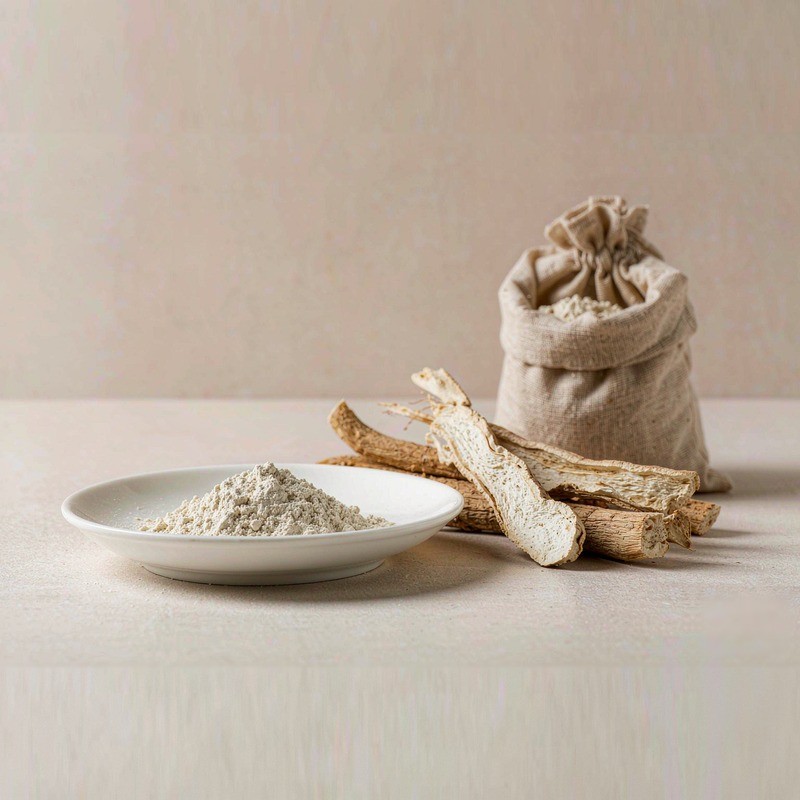
Althaea officinalis root is what "marshmallow root" means. Leaf powder from the same plant is cheaper and looks similar once milled, and it turns up in root powder shipments more often than anyone admits. Before milling, ask for photos of the dried roots and the sieve fraction. After milling, color is the tell: root powder runs off-white to pale beige, while leaf pushes it toward grey-green. If the lot looks minty, ask questions.
The root's value sits in its water-soluble polysaccharides. That fraction moves with root age, harvest window, and drying temperature. A lot dried too hot still passes moisture and ash but gives up extract yield. If your formulation depends on the water-extractable fraction, ask for a swelling index or water-extract value on every lot, not just on the approval sample. Any mill handling this root properly can run the test. A supplier who waves it off is telling you something.
Parameter | Typical limit | Why it matters |
Appearance | Off-white to pale beige | Green tint suggests leaf admixture |
Particle size | 60 / 80 / 100 / 200 mesh | See mesh guide below |
Moisture | ≤ 8% | Flow, caking, shelf life |
Total ash | ≤ 10% | Soil and grit pickup at harvest |
SO2 residue | ≤ 30 ppm | Flags sulfur fumigation |
Heavy metals | Pb, Cd, As, Hg per EU limits | Market compliance |
Pesticides | EU MRL or your own list | Market compliance |
Microbiology | TPC, yeast & mold, E. coli, Salmonella absent | Standard lot release |
60 mesh. Coarse. Best flow, used in tea blends and capsule fills where dosing speed matters.
80 mesh. The workhorse for most supplement powder blends.
100 mesh. Drink mixes and sachets.
200 mesh. Fine suspensions and cosmetic textures. Dusty to handle, compacts in transit, and needs a mixer that breaks agglomerates.
Washed root goes into low-temperature drying, under 50°C, for a day or more depending on root diameter. Too much heat and the extract fraction drops; too little and moisture climbs back in the bag. Dried root is coarse-crushed, milled, passed under metal detection, sieved, and packed. The two failure points we watch are dryer temperature drift and torn sieve screens that let oversize particles through. Ask how your supplier monitors both.
COA, specification sheet, MSDS, allergen statement, non-GMO declaration, and a non-irradiation declaration. Retained samples are kept for 24 months, and third-party verification is available on request. Identity is confirmed macroscopically and microscopically at intake; TLC or DNA barcoding can be added per lot if your market requires it.
Standard packing is 25 kg fiber drums with a double PE liner; 20 kg kraft-aluminum bags on request. Stock mesh sizes ship in 7 to 15 days. Custom mesh runs start at 500 kg. Samples of 200 g go out with the COA of the current lot.
Send the target spec instead of a price request. You will get back a COA from the lot in stock and a sample to run against it. That comparison settles most questions faster than a quotation does.