![Shaanxi Lingkang Times Biotechnology Co., LTD]() Shaanxi Lingkang Times Biotechnology Co., LTD
Shaanxi Lingkang Times Biotechnology Co., LTD

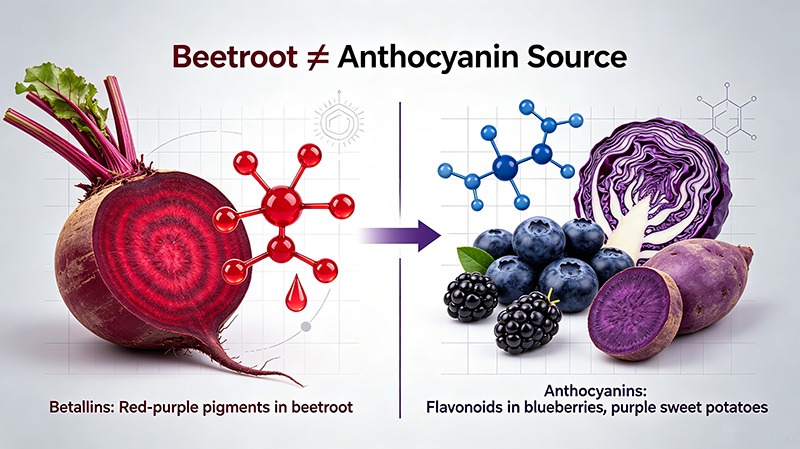
Many health articles and product promotions claim that most purple and red fruits and vegetables are rich in anthocyanins. Accordingly, brightly colored beetroot is often categorized as an anthocyanin-containing food. However, from a phytochemical perspective, beetroot does NOT contain anthocyanins. Its vivid red color comes from betalains instead, and the two substances must not be confused.
Does beetroot contain anthocyanins?
There is a well-established rule in plant evolution: most plants of the order Caryophyllales synthesize only betalains and cannot produce anthocyanins. Conversely, plants that generate anthocyanins generally do not produce betalains. These two pigments are largely mutually exclusive in nature.Beetroot belongs to the Amaranthaceae family under Caryophyllales. It naturally produces betalains and contains no anthocyanins.
People frequently mix up these two pigments due to their similarities. Both are water-soluble natural red pigments with notable antioxidant properties, widely used in food coloring and dietary raw materials. Chemically speaking, however, they are completely distinct compounds.Anthocyanins are flavonoid polyphenols, found in blueberries, red cabbage, purple sweet potatoes, black goji berries and red radishes. Betalains are nitrogen-containing alkaloid pigments; typical sources include red beetroot, red-fleshed pitaya, prickly pear and purslane.
They also differ greatly in physical and chemical properties. Anthocyanins are highly pH-sensitive, turning bluish-green under alkaline conditions and prone to fading under high heat. Betalains feature relatively better heat resistance and exhibit different color changes with pH levels, which offers a simple way to distinguish them.
We should recognize beetroot’s genuine nutritional strengths instead of incorrectly associating it with anthocyanins. Its key characteristic nutrients fall into three categories. First, signature betalains with antioxidant and anti-inflammatory effects. Second, natural inorganic nitrates, which stimulate nitric oxide production in the human body to boost blood circulation — a trait favored by fitness enthusiasts. Besides, beetroot is abundant in folate, soluble dietary fiber and various minerals.
Important Reminder for the Raw Material Industry
This point is especially critical for professionals engaged in plant extracts, health supplements and raw material trading. Labeling beetroot as an anthocyanin source on product brochures, test reports or marketing materials constitutes a factual error regarding ingredients.If you want to source anthocyanin raw materials, choose fruits and vegetables naturally high in anthocyanins such as purple grapes, bilberries, purple sweet potatoes and elderberries. For betalain supply, beetroot remains a classic and mature raw material option.
In summary, we cannot judge whether produce contains anthocyanins merely by its reddish-purple appearance. Bright red color does not equal anthocyanins. Distinguishing between betalains and anthocyanins helps us avoid misleading online health content and enables accurate decision-making for daily diet and botanical raw material procurement.